Solve for the Exact Same Eigenvalues Again Using an Optimization Approach
Abstruse
The newspaper proposes a multi-domain approach to the optimization of the dynamic response of an underactuated vibrating linear system through eigenstructure assignment, by exploiting the concurrent design of the mechanical properties, the regulator and state observers. The approach relies on handling simultaneously mechanical design and controller synthesis in order to overstate the set of the doable performances. The underlying novel thought is that structural properties of controlled mechanical systems should be designed considering the presence of the controller through a concurrent arroyo: this can considerably improve the optimization possibilities. The method is, showtime, developed theoretically. Starting from the definition of the set of feasible organization responses, defined through the feasible mode shapes, an original formulation of the optimality criterion is proposed to properly shape the allowable subspace through the optimal modification of the design variables. A proper choice of the modifications of the elastic and inertial parameters, indeed, changes the space of the allowable eigenvectors that can be accomplished through active command and allows obtaining the desired performances. The trouble is and so solved through a rank-minimization with constraints on the design variables: a convex optimization problem is formulated through the "semidefinite embedding lemma" and the "trace heuristics". Finally, experimental validation is provided through the assignment of a mode shape and of the related eigenfrequency to a cantilever beam controlled by a piezoelectric actuator, in order to obtain a region of the axle with negligible oscillations and the other 1 with large oscillations. The results prove the effectiveness of the proposed approach that outperforms agile control and mechanical design when used lone.
Introduction
Performance optimization through concurrent mechanical and command design
Dynamic structural optimization in mechanisms and structures, oftentimes denoted as dynamic response topology optimization, aims at finding the optimal mass and stiffness distribution for obtaining the desired dynamic performances, by optimizing a price function while satisfying constraints on the feasible parameters. The crux is defining such a toll part, or performance alphabetize, that properly represents the physical problem and its relationship with the desired performances and should be easily solvable (Yan and Wang 2020). Other features, such as convexity to ensure that global optimal solutions tin can be found regardless of the initial guess (Belotti et al. 2016), are also valuable to ensure meaningful results and actual optimal results. A reliable definition of the cost part imposes considering the presence of the controller likewise, whenever the construction operates with airtight-loop controllers. Indeed, the ever-growing integration between mechanical systems and active devices, such as actuators, imposes a new multidisciplinary and control-oriented pattern approach. Design choices must handle the tight interactions between the mechanical pattern (due east.g. the mass and stiffness properties) and the synthesis of its controller, which besides comprises the definition of the actuated and sensed variables and the development of land observers. In practice, choices should be fabricated with respect to the mechanical parameters needed to achieve the desired performances of the controlled system and the cost office adopted in the optimization should therefore represent this relation. The use of sequential, or fifty-fifty worse, decoupled pattern approaches that separately consider the mechanical and the control domains, does non tackle effectively these critical interactions and imposes trial-and-error iterations that might converge to less effective solutions. The recent literature on design of actuated mechanical systems has, in dissimilarity, highlighted the need for concurrent and multi-domain approaches (Hehenberger et al. 2013), since the knowledge of the controller limits and achievable performances allows for optimizing mechanical constructions and obtaining cost constructive solutions. The idea of concurrent design exploiting both active and passive design variables has been recently proved to be very effective in other field of multi-objective optimization for engineering, such as in building engineering (Lee 2019) and control of sound radiation (Zhai et al. 2017). There is, however, still a lack of methods to be used in control-oriented pattern of underactuated mechanical systems, especially when flexible components are employed either to exploit their resonance features (due east.grand. resonators) or to reduce the overall mass, at the expense of a stiffness reduction.
Near of the approaches proposed and then-far are "directly methods" that evaluate different solutions obtained by irresolute some organisation parameters. For example, these methods often rely on co-simulation–based integrated optimization methods, which iterate by simulating different solutions and past predicting the effect of the imposed modifications or the selected controller. An opposite strategy is the ane of "changed" methods whose aim is to compute the modifications necessary to obtain the prescribed dynamic behaviour past solving some mathematical problems, such as changed eigenvalue issues. The evolution of changed, concurrent approaches for the design of actuated mechanical systems requires the explicit definition of the performance targets, e.g. through some metrics of measurable backdrop, and of numerical methods for achieving such performances.
Amongst the dissimilar approaches, a common and effective approach for defining the desired dynamic properties in vibrating systems is through the shapes, natural frequencies and damping of their vibrational modes, i.e. the eigenstructure. A less investigated field is the assignment of antiresonances (see due east.g. Belotti et al. 2020; Richiedei et al. 2019) or antiresonances together with natural frequencies (Richiedei et al. 2020). Natural frequencies and damping, i.e. the eigenvalues of the eigenvalue problem, fix stability and speed of response, while the mode shapes, i.e. the eigenvectors, define the spatial shape of the vibration and prepare the sensitivities of the corresponding eigenvalues to model parameters. Even though the control theory is usually focused on simply the assignment of eigenvalues, every bit proved by the several approaches developed in the recent literature, assigning the eigenvectors also tin be more than advantageous (Moore 1976). Hence, several approaches take been proposed to solve the task of eigenstructure assignment (EA), by exploiting either passive modifications of the system parameters (such equally masses or stiffnesses) through dynamic structural modification (see e.yard. Jihong and Weihong 2006; Hernandes and Suleman 2014; Belotti et al. 2016; Belotti et al. 2018b; Thomas et al. 2020), or agile command (see e.g. Schulz and Inman 1994, Triller and Kammer 1997, Kim et al. 1999, Zhang et al. 2014). The ever-growing integration between mechanical systems and active devices, such as actuators, imposes however a more integrated arroyo that takes advantage of the features of both active and passive approaches to boost the doable performances. Hence, design choices must handle the tight interactions betwixt the mechanical design of a system and the synthesis of its controller, which also comprises the development of land observers (Caracciolo et al. 2008).
In the lite of this need, the employ of "hybrid design approaches" (i.e. combined active and passive approaches) to eigenstructure assignment is very promising, as it has been already proved in other similar applications, such as pole placement in asymmetric systems (Ouyang 2011) or vibration damping through mechanical (Corr and Clark 2002) or piezoelectric dampers (Tang and Wang 2004). The idea of applying hybrid approaches to assign eigenvalues and the related eigenvectors has been originally proposed in Richiedei and Trevisani (2017) and and then extended in Belotti and Richiedei (2018) to overcome the limitations of using either passive modifications or agile control alone in the challenging task of EA. On the one hand, the performances doable through dynamic structural modification are limited past the symmetric nature of the modifications and by the constraints on their feasible values. On the other mitt, the set of eigenvectors that tin be achieved through land-feedback active control is severely restricted: system controllability does not let assigning whatsoever arbitrary eigenvector, unless the system is fully actuated. Indeed, all the achievable eigenvectors lie in a subspace which depends on the "mechanical properties" of the system (i.e. stiffness, mass and damping matrices) and of the topology of the actuation system (Moore 1976). Hence, EA is very challenging for underactuated systems, and especially in the presence of rank-one control (i.e. in the presence of only one contained control force). As previously mentioned, hybrid control allows achieving better results in EA: the modification of inertial and rubberband parameters is exploited to change the allowable subspace in such a way that the desired eigenpairs can be assigned through closed-loop control.
Objectives and contributions of the newspaper
Past taking advantage of the theoretical formulation introduced by Belotti and Richiedei (2018), this newspaper proposes an integrated arroyo to EA for a cantilever beam controlled through a piezoelectric actuator and validates it experimentally. Beams are widely used as structural elements in many engineering bug, and the optimal design of these systems is yet investigated in the very recent literature in the field of structural optimization, such as for example in Aydin et al. (2020) or Hauser and Wang (2018). A unlike goal is investigated in this paper, and a new pattern method is proposed through a concurrent and multi-domain approach. The target of the pattern assumed in this piece of work to show the need of a concurrent optimization approach is to modify both the shape and the frequency of a vibrational mode of the beam to reduce vibrations near the clamped finish, while magnifying the oscillations near the free stop. This is an case of vibration solitude, i.e. shaping vibrations so that they take much smaller amplitude in concerned expanse than in the remaining part of the construction, which is an application where EA is very bonny (come across e.thousand. Tang and Wang 2004; Andry et al. 1983). Such a beam optimization might exist useful, for example, for designing compliant mechanisms which often are based on cantilever beams. Despite its credible simplicity, such a task is difficult to solve if passive command or active control are used alone. Indeed, the presence of rank-one command in a multi-dimensional arrangement does not allow the control specifications to be achieved. The assay of this limitation through the definition of an "commanded subspace" leads to the conception of a new optimality criterion for the structural optimization. The problem is then solved equally a rank-minimization with constraints on the design variables. A benefit of this conception is that a convex problem is obtained, and there is no need to perform repetitious solution of the generalized eigen-problem, which is ordinarily recognized as a cumbersome calculation in topology optimizations (see e.one thousand. the discussion provided in Zheng et al. 2017).
The application of the method to a real device introduces another disquisitional issue: since no directly measurement of the whole state vector is possible, a state observer must be implemented for the real-time estimation of the state to exist fed back. The control and observation spillover (Caracciolo et al. 2008) and the perturbation of the fashion shapes due to the utilize of reduced-social club observers are therefore handled in the newspaper, and an arroyo to evaluate their touch is proposed. Hence, the observer synthesis tin be also included in this improved integrated approach, since the separation principle between controller and observer does non hold anymore in cases like the i discussed hither. Some preliminary results of this research have been presented in the conference paper (Belotti et al. 2017). Here, both an improved theory and a new experimental campaign are proposed, to include the observer synthesis within the design procedure in a more integrated style and hence extend the thought of concurrent and multidisciplinary design to the observer synthesis. A more effective arroyo for the numerical optimization through the rank-minimization is exploited also.
The paper develops the theory with reference to the mentioned cantilever beam controlled through a piezoelectric actuator: the models (Department 2), the EA method (Sections 3 and 4) and the bug related to the observer (Department 5) will be discussed with reference to such a organisation, which tin be assumed as a meaningful example and for which detailed experimental results are reported in Section six. However, all the methods and models can be extended and practical to other underactuated vibrating systems, with an arbitrary number of control forces and in the presence of damping likewise.
Organization model
Model of the beam
Let us presume that the cantilever axle is modelled through a suitable number of finite elements, such as beam elements, leading to a model with N degrees of liberty (DOFs), collected in vector q . The finite element model of the beam is represented by the beam mass (M ∈ℝ N ×N ), stiffness (K ∈ℝ N ×North ) and damping (C ∈ℝ N ×N ) matrices, where f C (t) is the vector of the external control forces (or torques), B the distribution matrix of the control forces, f D (t) the vector of the external disturbance forces (or torques) and B D the distribution matrix of the disturbance forces. Finally, t is the fourth dimension. Hence, the system is represented through the following linear, time-invariant model:
$$ \mathbf{Thousand}\ddot{\boldsymbol{q}}(t)+\mathbf{C}\dot{\boldsymbol{q}}(t)+\mathbf{K}\boldsymbol{q}(t)=\mathbf{B}{\boldsymbol{f}}_C(t)+{\mathbf{B}}_D{\boldsymbol{f}}_D(t) $$
(1)
Two obvious assumptions are made on B: it is a total rank matrix, with North B being its rank, and information technology ensures that the system is fully controllable, i.due east. rank([M λ i ii +C λ i +One thousand B]) =N for any open-loop eigenfrequencies λ i . The latter requirements ensure that whatsoever set of desired eigenfrequencies can be obtained, and it is a necessary (but not sufficient) requirement in the example of active command. Additionally, since underactuated systems are discussed here, N B <Due north.
In the case of lightly damped systems, information technology is a common practice in the literature to represent the organisation through an undamped model and so to codify the structural modification trouble with real eigenvectors and eigenvalues. This supposition, which is causeless in the following of the paper, drastically simplifies the design problem and improves its numerical workout since existent functions are obtained. Nonetheless, the theory proposed can exist extended to dissipative systems where damping cannot be neglected, as shown in Belotti and Richiedei (2018).
Model of the piezoelectric actuator
The control force f C (t) is assumed to be exerted by one or more than piezoelectric actuators, which are here modelled through linear theory proposed by Gaudenzi et al. (2000). Nonlinearities, such as hysteresis or proceeds variability, are neither modelled nor accounted for, and hence are simply regarded as uncertainties that crusade minor deviations from the theoretical results.
The strength distribution vector for each actuated finite element (denoted B actuated), which is assumed to be actuated by just one actuator, is computed past integrating the shape function of the Euler-Bernoulli beam over the length l of the finite element, which equals the length of the piezoelectric patch:
$$ {\mathbf{B}}_{\mathrm{actuated}}={\int}_0^l{\left\{-\frac{6}{fifty^2}+\frac{12s}{fifty^three}\kern0.5em -\frac{4}{fifty}+\frac{6s}{fifty^2}\kern0.5em \frac{6}{l^two}-\frac{12s}{l^iii}\kern0.5em -\frac{two}{l}+\frac{6s}{l^2}\right\}}^T ds $$
(2)
The remaining entries of B are nothing.
By integrating (two), each actuator is modelled as ii reverse torques of magnitude F C applied at both ends of the piezoelectric patch, every bit represented in Fig. 1. These torques are, in turn, modelled as proportional to the applied voltage (Preumont 2011), with a proceeds whose value tin exist identified through experimental analysis or through data provided by the patch manufacturer.

Model of the experimental setup (cantilever beam and slip-table)
Finally, the inertial and rubberband contributions of the actuator have been too represented through additive mass and stiffness matrices Gaudenzi et al. (2000) based on the Euler-Bernoulli linear theory, named M PZ and K PZ , respectively:
$$ {\displaystyle \begin{assortment}{c}{\mathbf{M}}_{PZ}=\frac{m_{pz}}{420}\left[\begin{array}{ccc}156& 22l& 54\kern0.5em -13l\\ {}22l& 4{50}^2& 13l\kern0.5em -3{50}^2\\ {}\begin{assortment}{c}54\\ {}-13l\end{array}& \begin{array}{c}13l\\ {}-three{fifty}^2\end{assortment}& \begin{assortment}{cc}\begin{assortment}{c}156\\ {}-22l\end{assortment}& \brainstorm{array}{c}-22l\\ {}4{l}^2\terminate{assortment}\finish{assortment}\terminate{array}\right]\\ {}{\mathbf{K}}_{PZ}={E}_{pz}\frac{h_{eq}^3}{iii}\left[\begin{assortment}{ccc}12/{l}^iii& 6/{50}^2& \begin{array}{cc}-12/{fifty}^3& 6/{fifty}^two\end{array}\\ {}6/{fifty}^2& 4/l& \begin{array}{cc}-6/{fifty}^2& 2/l\end{assortment}\\ {}\begin{array}{c}-12/{l}^three\\ {}six/{l}^2\end{assortment}& \begin{array}{c}-6/l\\ {}2/l\end{array}& \begin{array}{cc}\begin{array}{c}12/{50}^3\\ {}-6/{l}^2\end{array}& \begin{array}{c}-6/{l}^2\\ {}4/l\end{array}\end{assortment}\end{array}\right]\terminate{array}} $$
(three)
The following properties of the piezoelectric patch have been introduced: m pz is the overall mass, Due east pz is the Young modulus, h pz is the thickness, and h eq has been defined every bit follows:
$$ {h_{eq}}^three={h_{pz}}^3+three{\delta}^two{h}_{pz}-3\delta {h}_b{h}_{pz}-iii\delta {h_{pz}}^two+\frac{3}{iv}{h_b}^2{h}_{pz}+\frac{3}{ii}{h}_b{h_{pz}}^ii $$
(4)
In (4), δ denotes the perturbation of the neutral axis due to the presence of the actuator bonded to the axle, compared with the ane of the beam without piezoelectric patch.
Mode shape assignment through state-feedback control
The aim of EA through country-feedback control is to calculate the proceeds matrices F and G leading to the desired eigenpairs, henceforth denoted as \( {\left(\overset{\sim }{\lambda },\overset{\sim }{\boldsymbol{u}}\right)}_i \):
$$ {\boldsymbol{f}}_C(t)=-\left({\mathbf{F}}^{\mathrm{T}}\dot{\boldsymbol{q}}(t)+{\mathbf{G}}^{\mathrm{T}}\boldsymbol{q}(t)\right) $$
(v)
Land-feedback, likewise as sometimes land derivative feedback (see east.g. Araújo et al. 2016), are widely adopted in assigning the organisation poles whenever the organisation is controllable. The controllability assumption is, in contrast, not sufficient for EA, since the necessary condition for obtaining an arbitrary mode shape is more than restrictive. Indeed, the pair \( {\left(\overset{\sim }{\lambda },\overset{\sim }{\boldsymbol{u}}\right)}_i \) is an eigenpair of the controlled organisation if and only if it satisfies the following eigenvalue problem:
$$ \left[\mathbf{M}{{\overset{\sim }{\lambda}}_i}^2+\mathbf{C}{\overset{\sim }{\lambda}}_i+\mathbf{Chiliad}\correct]{\overset{\sim }{\boldsymbol{u}}}_i+\mathbf{B}\left[{\overset{\sim }{\lambda}}_i{\mathbf{F}}^T+{\mathbf{M}}^T\correct]{\overset{\sim }{\boldsymbol{u}}}_i=\mathbf{0} $$
(6)
By defining vector \( {\boldsymbol{\phi}}_i=\left[{\overset{\sim }{\lambda}}_i{\mathbf{F}}^T+{\mathbf{Thousand}}^T\right]{\overset{\sim }{\boldsymbol{u}}}_i \), (6) is equivalent to the following condition:
$$ \left[\mathbf{M}{{\overset{\sim }{\lambda}}_i}^2+\mathbf{C}{\overset{\sim }{\lambda}}_i+\mathbf{K}\kern0.5em \mathbf{B}\correct]\left[\begin{array}{c}{\overset{\sim }{\boldsymbol{u}}}_i\\ {}{\boldsymbol{\phi}}_i\end{array}\right]=\mathbf{0} $$
(7)
\( {\boldsymbol{\phi}}_i\in {\mathbb{C}}^{N_b} \) is an arbitrary vector, since the gain matrices are arbitrary. Hence \( {\overset{\sim }{\boldsymbol{u}}}_i \) is an assignable eigenvector if and just if \( \left[\begin{array}{c}{\overset{\sim }{\boldsymbol{u}}}_i\\ {}{\boldsymbol{\phi}}_i\end{array}\right] \) belongs to the zip-infinite (represented through the operator \( \mathcal{N} \)) of \( \left[\mathbf{Yard}{{\overset{\sim }{\lambda}}_i}^2+\mathbf{C}{\overset{\sim }{\lambda}}_i+\mathbf{Yard}\kern0.75em \mathbf{B}\correct] \):
$$ \left[\begin{assortment}{c}{\overset{\sim }{\boldsymbol{u}}}_i\\ {}{\boldsymbol{\phi}}_i\end{array}\right]\in \mathcal{N}\left(\left[\mathbf{M}{{\overset{\sim }{\lambda}}_i}^ii+\mathbf{C}{\overset{\sim }{\lambda}}_i+\mathbf{Thousand}\kern0.5em \mathbf{B}\right]\right) $$
(8)
The infinite \( \Psi \left({\overset{\sim }{\lambda}}_i\correct)=\mathcal{N}\left(\left[\mathbf{M}{{\overset{\sim }{\lambda}}_i}^2+\mathbf{C}{\overset{\sim }{\lambda}}_i+\mathbf{K}\kern0.5em \mathbf{B}\correct]\right) \) is named the allowable subspace and spans all the eigenvectors, associated to \( {\overset{\sim }{\lambda}}_i \), that can be achieved through active control for the arrangement under investigation.
If the system is controllable, then \( \dim \Psi \left({\overset{\sim }{\lambda}}_i\right)=\operatorname{rank}\left(\mathbf{B}\correct) \). Hence, the number of arbitrary terms of the eigenvectors is equal to the number of independent control forces. Hence, whatever capricious eigenvector cannot exist commonly obtained through agile command in the case of underactuated systems (i.east. rank(B) <N). In contrast, any arbitrary eigenvector can be obtained in the case of fully-actuated system (i.e. rank(B) =N). Equation (8) clearly corroborates that the achievable performances of the controlled organization are constrained by the features of the mechanical construction, as stated in Department 1. Hence, this limitation should be accounted in the stages of the mechanical design.
Dynamic structural modification oriented to state-feedback control
In the post-obit developments, velocity feedback and damping matrix are not considered, to represent the instance in which it is not desired to clammy a lightly-damped system. Hence, real eigenvectors and eigenvalues are adopted. However, the theory can be too extended in the case of damped systems, every bit shown past Belotti and Richiedei (2018).
Permit us assign a set of N e eigenpairs \( {\left(\overset{\sim }{\lambda },\overset{\sim }{\boldsymbol{u}}\right)}_i \). Hybrid command consists in modifying the commanded subspace \( \Psi \left({\overset{\sim }{\lambda}}_i\right) \) through ΔM and ΔK to obtain a new subspace \( \chapeau{\Psi}\left({\overset{\sim }{\lambda}}_i\right) \) to which the desired eigenvector belongs:
$$ \left[\begin{array}{c}{\overset{\sim }{\boldsymbol{u}}}_i\\ {}{\boldsymbol{\phi}}_i\cease{array}\right]\in \mathcal{N}\left(\left[\left(\mathbf{M}+\Delta \mathbf{M}\right){{\overset{\sim }{\lambda}}_i}^two+\left(\mathbf{K}+\Delta \mathbf{Thou}\right)\kern0.75em \mathbf{B}\right]\correct)=\hat{\Psi}\left({\overset{\sim }{\lambda}}_i\right) $$
(ix)
for some arbitrary \( {\boldsymbol{\phi}}_i\in {\mathbb{C}}^{N_b} \).
The calculation of ΔM and ΔK satisfying (9) can be solved as a rank-minimization problem. This formulation is advantageous since several effective numerical algorithms bug accept been recently developed. Additionally, it is non necessary to compute the commanded subspace.
In lodge to adopt the rank-minimization formulation, the eigenvalue problem of the modified organization is written as the following linear system:
$$ \mathbf{B}{\boldsymbol{\phi}}_i=\left[\left(\mathbf{M}+\Delta \mathbf{M}\right){{\overset{\sim }{\lambda}}_i}^2+\left(\mathbf{Thou}+\Delta \mathbf{K}\right)\right]{\overset{\sim }{\boldsymbol{u}}}_i $$
(x)
that tin be expressed in the following form, with the obvious meaning of d i :
$$ \mathbf{B}{\boldsymbol{\phi}}_i={\boldsymbol{d}}_i $$
(eleven)
Equation (xi) has a solution if and only if the following condition holds:
$$ \operatorname{rank}\left(\left[\mathbf{B}|{\boldsymbol{d}}_i\right]\correct)=\operatorname{rank}\left(\mathbf{B}\right) $$
(12)
By introducing matrix \( \mathbf{D}=\left[{\boldsymbol{d}}_1|\dots |{\boldsymbol{d}}_{N_e}\right]\in {\mathbb{R}}^{North\times {N}_e} \), the system in (11) tin can be solved for any i = ane, …, N east if and only if:
$$ \operatorname{rank}\left(\left[\mathbf{B}|\mathbf{D}\correct]\right)={N}_B. $$
(13)
Since rank([B|D]) = rank(B) + rank([I −BB +]D), such a rank condition, in turn, holds if and but if
$$ \operatorname{rank}\left(\left[\mathbf{I}-\mathbf{B}{\mathbf{B}}^{+}\correct]\mathbf{D}\right)=0. $$
(14)
where B + is the pseudoinverse of matrix B. The unique exact solution of (fourteen) is [I −BB +]D = 0. Nonetheless, given the presence of several requirements on the desired eigenvectors, which are non ensured to exist doable especially when highly underactuated systems are handled, an gauge solution of (14) should be sought. The difficulties in achieving an exact solution are exacerbated by the presence of constraints on the topologies of ΔM and ΔK and on the commanded system modifications, due to constraints. Hence, information technology is proposed to transform the exact trouble to an optimization-based formulation aimed at finding ΔM and ΔK that solve the post-obit rank-minimization problem:
$$ {\displaystyle \begin{array}{cc}\operatorname{minimize}& \operatorname{rank}\left(\left[\mathbf{I}-\mathbf{B}{\mathbf{B}}^{+}\correct]\mathbf{D}\right)\\ {}\mathrm{discipline}\ \mathrm{to}& \left(\boldsymbol{\Delta} \mathbf{M},\boldsymbol{\Delta} \mathbf{K}\right)\in \Gamma \end{array}} $$
(15)
Γ is the set of the allowable modifications of the mass and stiffness parameters in ΔM and ΔK. In this way, the beingness of a solution that optimally approximates the desired eigenvectors is assured for any non-empty Γ. The modification trouble of the allowable subspaces can therefore be idea equally finding the modification matrices, such that (15) holds.
The solution of the rank-minimization problem (15) can exist performed through some heuristic algorithms for rank-minimization. In particular, the semidefinite embedding lemma proposed past Fazel et al. (2003) can be adopted to solve the problem, by taking reward of the then-chosen trace heuristics which replaces the rank with the trace, every bit often done in solving several optimization problem (meet e.g. Fazel et al. (2001)). This formulation leads to a convex minimization problem. Post-obit such a theoretical result, problem in (fifteen) is further recast as follows:
$$ {\displaystyle \begin{array}{cc}\operatorname{minimize}& \mathrm{trace}\kern0.33em \left(\operatorname{diag}\left(\mathbf{Y},\mathbf{Z}\correct)\right)\\ {}\mathrm{subject}\ \mathrm{to}& \left\{\brainstorm{assortment}{c}\left[\brainstorm{array}{cc}\mathbf{Y}& \left[\mathbf{I}-\mathbf{B}{\mathbf{B}}^{+}\right]\mathbf{D}\\ {}{\mathbf{D}}^T{\left[\mathbf{I}-\mathbf{B}{\mathbf{B}}^{+}\right]}^T& \mathbf{Z}\end{array}\correct]\succcurlyeq 0\\ {}\left(\boldsymbol{\Delta} \mathbf{M},\boldsymbol{\Delta} \mathbf{Chiliad}\right)\in \Gamma .\end{assortment}\right.\finish{array}} $$
(16)
for 2 capricious symmetric matrices Y ∈ℝ m ×grand and Z ∈ℝ north ×n . The inequality ≽0 denotes that the matrix on the left-paw side should exist positive semidefinite. The optimization problem obtained is convex if the feasibility constraint set Γ is chosen every bit a convex gear up. This is a very important characteristic of the proposed problem.
In one case the modifications matrices take been computed by solving numerically the rank-minimization problem in (sixteen), the gains of the controller should be calculated through ane of the several methods for eigenstructure assignment. If the desired eigenvector \( {\overset{\sim }{\boldsymbol{u}}}_i \) does not belong to the allowable subspace of the modified system, it should be replaced with its orthogonal project onto the allowable subspace of the modified system (Richiedei and Trevisani 2017–Andry et al. 1983), named \( {\overset{\sim }{\boldsymbol{u}}}_{ip} \):
$$ {\overset{\sim }{\boldsymbol{u}}}_{ip}={\boldsymbol{\Psi}}_i{\left({\boldsymbol{\Psi}}_i^T{\boldsymbol{\Psi}}_i\right)}^{-ane}{\boldsymbol{\Psi}}_i^T{\overset{\sim }{\boldsymbol{u}}}_i $$
(17)
Ψ i (for any index i) is a matrix whose columns span the allowable subspace of the modified system. \( {\overset{\sim }{\boldsymbol{u}}}_{ip} \) is the commanded eigenvector that provides the tightest approximation of the desired one \( {\overset{\sim }{\boldsymbol{u}}}_i \), whenever \( {\overset{\sim }{\boldsymbol{u}}}_i \) is unfeasible. The project of the desired eigenvector onto the allowable subspace of the modified organisation provides a better approximation than the projection onto the allowable subspace of the original system, cheers to the clever synthesis of ΔM and ΔK.
Introduction of a state-observer
In the implementation of state-feedback control, it is a common need to replace the measured, actual state (\( \dot{\boldsymbol{q}} \) and q ) with the estimated one (Caracciolo et al. 2008). Indeed, measurement of all the land variables in structures or in multibody systems is normally very difficult (Palomba et al. 2017; Sanjurjo et al. 2018). Estimation is provided by a state observer (or country estimator), which reconstructs missing state variables by merging the model, expressed equally a beginning-club state-infinite model, and a meaningful fix of measurements with a prediction-correction logic (Palomba et al. 2017). In the light of a concurrent blueprint, the upshot of the country observer should exist included in the overall approach too, and the limitations due to the computational effort required for existent time estimation should be investigated.
To develop a state observer, a get-go-lodge conception of the arrangement model in (ane) is needed, by writing it in the following grade:
$$ \left\{\brainstorm{array}{c}\ddot{\boldsymbol{q}}(t)\\ {}\dot{\boldsymbol{q}}(t)\end{array}\right\}=\left[\begin{array}{cc}-{\mathbf{1000}}^{-1}\mathbf{C}& -{\mathbf{G}}^{-1}\mathbf{Chiliad}\\ {}\mathbf{I}& \mathbf{0}\stop{assortment}\correct]\left\{\begin{array}{c}\dot{\boldsymbol{q}}(t)\\ {}\boldsymbol{q}(t)\end{array}\correct\}+\left\{\begin{array}{c}{\mathbf{G}}^{-one}\mathbf{B}\\ {}\mathbf{0}\end{array}\right\}{\boldsymbol{f}}_C(t)+\left\{\begin{array}{c}{\mathbf{Grand}}^{-1}{\mathbf{B}}_D\\ {}\mathbf{0}\end{assortment}\right\}{\boldsymbol{f}}_D(t) $$
(18)
The state-infinite model in (18) tin exist written in the more compact form of (xix), with the obvious definition of matrices A χ , B Cχ , B Dχ and C χ and of the state vector \( \boldsymbol{\upchi} =\left\{\begin{assortment}{c}\overset{\cdot }{\boldsymbol{q}}\\ {}\boldsymbol{q}\end{array}\right\} \):
$$ \left\{\begin{array}{l}\dot{\boldsymbol{\upchi}}(t)={\mathbf{A}}_{\chi}\boldsymbol{\upchi} (t)+{\mathbf{B}}_{C\chi}{\boldsymbol{f}}_C(t)+{\mathbf{B}}_{D\chi}{\boldsymbol{f}}_D(t)\\ {}\mathbf{y}(t)={\mathbf{C}}_{\chi}\boldsymbol{\upchi} (t)\end{array}\right. $$
(xix)
An effective approach to the synthesis of state observers for linear vibrating systems is the employ of a linear Luenberger observer, such as the Kalman filter, based on a reduced-society model on a modal base. Such a choice is motivated by the need of reducing the computational endeavor for the existent-time solution of the observer differential equations, by reducing the number of the equations, i.east. the size of the model adopted for land estimation. The use of reduced model is widely proposed in the literature for simplifying both the model-based design (Palomba et al. 2015; Xiao et al. 2020; Delissen et al. 2020) and the control synthesis (Caracciolo et al. 2008). The model in (xix) is therefore recast in the modal canonical class by using the linear transformation
$$ \mathbf{z}(t)=\mathbf{T}\boldsymbol{\upchi } (t), $$
(twenty)
where vector z denotes the modal coordinates of the first-gild model and T ∈ℝ 2North × 2Due north is the transformation matrix, leading to the following linear system:
$$ \left\{\begin{assortment}{l}\dot{\mathbf{z}}\ (t)={\mathbf{A}}_Z\mathbf{z}(t)+{\mathbf{B}}_{CZ}{\boldsymbol{f}}_C(t)+{\mathbf{B}}_{DZ}{\boldsymbol{f}}_D(t)\\ {}\mathbf{y}\ (t)={\mathbf{C}}_Z\mathbf{z}(t)\finish{array}\correct. $$
(21)
The new model matrices are obtained as follows: A Z =TA χ T −1, B CZ =TB Cχ , B DZ =TB Dχ and C Z =C χ T −1.
Reduction consists in sectionalization the modal base of operations z into a set of less relevant modes z Due north , that are ordinarily the highest frequency ones, and a set of dominant ones z R , that are unremarkably the lowest frequency ones or those with the greatest contribution to the arrangement response (Palomba et al. 2015):
$$ \left\{\brainstorm{array}{l}\left\{\brainstorm{array}{c}{\dot{\mathbf{z}}}_{\mathrm{R}}(t)\\ {}{\dot{\mathbf{z}}}_{\mathrm{Northward}}(t)\end{array}\right\}=\left[\begin{array}{cc}{\mathbf{A}}_R& \mathbf{0}\\ {}\mathbf{0}& {\mathbf{A}}_N\end{assortment}\right]\left\{\brainstorm{array}{c}{\mathbf{z}}_{\mathrm{R}}(t)\\ {}{\mathbf{z}}_{\mathrm{N}}(t)\terminate{assortment}\right\}+\left\{\begin{array}{c}{\mathbf{B}}_{CR}\\ {}{\mathbf{B}}_{CN}\end{array}\right\}{\boldsymbol{f}}_C(t)+\left\{\begin{array}{c}{\mathbf{B}}_{DR}\\ {}{\mathbf{B}}_{DN}\cease{array}\right\}{\boldsymbol{f}}_D(t)\\ {}\mathbf{y}(t)=\left[{\mathbf{C}}_R\kern0.5em {\mathbf{C}}_N\right]\left\{\begin{array}{c}{\mathbf{z}}_{\mathrm{R}}(t)\\ {}{\mathbf{z}}_{\mathrm{N}}(t)\end{array}\right\}\end{array}\right. $$
(22)
The matrices in (22) are partitions of matrices in (21). The reduced order model is obtained past discarding z N (the so-called "neglected modes") and hence by just considering the subsystem fabricated by states z R (the and so-called "retained modes"):
$$ \left\{\begin{array}{l}{\dot{\mathbf{z}}}_{\mathrm{R}}(t)={\mathbf{A}}_R{\mathbf{z}}_{\mathrm{R}}(t)+{\mathbf{B}}_{CR}{\boldsymbol{f}}_C(t)+{\mathbf{B}}_{DR}{\boldsymbol{f}}_D(t)\\ {}\mathbf{y}(t)\simeq {\mathbf{C}}_R{\mathbf{z}}_{\mathrm{R}}(t)\end{array}\correct. $$
(23)
The neglected modes are those with the lowest observability and controllability, that are in practice weakly excited in the range of frequency of interest. Additionally, the low-laissez passer filtering of the sensor measurements and the actuator bandwidth farther reduce their contribution in the system response. Hence, their time trajectory can be effectively approximated as equal to zero and they tin exist discarded in the state observer (Caracciolo et al. 2008). The bear on of such a selection can be evaluated through the relations proposed in Section v.one.
Starting from the reduced model in (23), the following scheme of continuous-fourth dimension country observer tin can be implemented for estimating z R and hence χ (the hat is adopted to mark the estimated quantities):
$$ \left\{\begin{array}{l}{\lid{\dot{\mathbf{z}}}}_{\mathrm{R}}(t)={\mathbf{A}}_R{\hat{\mathbf{z}}}_R(t)+{\mathbf{B}}_{CR}{\boldsymbol{f}}_C(t)+{\mathbf{B}}_{DR}{\boldsymbol{f}}_D(t)+\boldsymbol{L}\left(\mathbf{y}(t)-\hat{\mathbf{y}}(t)\correct)\\ {}\chapeau{\mathbf{y}}(t)={\mathbf{C}}_R{\hat{\mathbf{z}}}_R(t)\end{array}\right. $$
(24)
Matrix L is the observer gain, that can be for example computed through the Kalman's theory, and aims at optimally trading between the prediction (i.e. \( {\mathbf{A}}_R{\hat{\mathbf{z}}}_R(t)+{\mathbf{B}}_{CR}{\boldsymbol{f}}_C(t)+{\mathbf{B}}_{DR}{\boldsymbol{f}}_D(t) \)) and the correction (i.e. \( \mathbf{y}(t)-\hat{\mathbf{y}}(t) \)).
Finally, the estimated values of the physical coordinates are computed through the inverse of the transformation matrix:
$$ \lid{\boldsymbol{\upchi}}(t)={\mathbf{T}}^{-1}\chapeau{\mathbf{z}}(t)={\mathbf{T}}^{-i}\left\{\begin{array}{c}{\lid{\mathbf{z}}}_{\mathrm{R}}(t)\\ {}{\hat{\mathbf{z}}}_{\mathrm{N}}(t)\end{array}\right\}={\mathbf{T}}^{-1}\left\{\begin{array}{c}{\hat{\mathbf{z}}}_{\mathrm{R}}(t)\\ {}\mathbf{0}\cease{assortment}\right\} $$
(25)
Since the neglected modes are those that do non significantly participate in the system response, they are, in practice, estimated as zero: \( {\hat{\mathbf{z}}}_N(t)=\mathbf{0} \) and \( {\chapeau{\dot{\mathbf{z}}}}_N(t)=\mathbf{0}\forall t \) (Caracciolo et al. 2008). Hence, the following relation is established for the control force, where G R denotes the command proceeds matrix expressed in the modal base of operations z:
$$ {\boldsymbol{f}}_C(t)=-\left[{\mathbf{F}}^{\mathrm{T}}\kern0.5em {\mathbf{G}}^{\mathrm{T}}\right]\hat{\boldsymbol{\upchi}}(t)=-\left[\begin{array}{cc}{\mathbf{F}}^{\mathrm{T}}& {\mathbf{G}}^{\mathrm{T}}\end{array}\right]{\mathbf{T}}^{-i}\left\{\begin{array}{c}{\lid{\mathbf{z}}}_R(t)\\ {}{\hat{\mathbf{z}}}_N(t)\end{assortment}\right\}=-{\mathbf{G}}_R^T{\lid{\mathbf{z}}}_{\mathrm{R}}(t). $$
(26)
Evaluation of the spillover due to the observer
A right tuning of the observer gain matrix L and a wise pick of the number of retained modes accept a crucial role in ensuring the achievement of the desired eigenpair. Indeed, the presence of neglected modes, whose amplitude is not negligible, causes control and observation spillover of the closed-loop system poles and perturbates the associated mode shapes. The impact of model truncation on the overall solution can be evaluated through the analysis of the perturbation on the eigenvalues and eigenvectors of interest due to the reduced order observer. These effects can be evaluated by defining the estimation mistake east(t) on the modes retained in the land observer:
$$ \mathbf{due east}(t)={\mathbf{z}}_{\mathrm{R}}(t)-{\hat{\mathbf{z}}}_{\mathrm{R}}(t) $$
(27)
and then past evaluating the eigenstructure of the augmented organisation. The model of the closed-loop system, with augmented state to include e(t), is the post-obit 1:
$$ \left\{\begin{array}{c}{\dot{\mathbf{z}}}_{\mathbf{R}}(t)\\ {}\dot{\mathbf{e}}(t)\\ {}{\dot{\mathbf{z}}}_{\mathbf{N}}(t)\end{assortment}\right\}=\left[\begin{array}{ccc}{\mathbf{A}}_R-{\mathbf{B}}_{CR}{\mathbf{G}}_R& {\mathbf{B}}_{CR}{\mathbf{1000}}_R& \mathbf{0}\\ {}\mathbf{0}& {\mathbf{A}}_R-\mathbf{50}{\mathbf{C}}_R& \mathbf{L}{\mathbf{C}}_N\\ {}-{\mathbf{B}}_{CN}{\mathbf{G}}_R& {\mathbf{B}}_{CN}{\mathbf{G}}_R& {\mathbf{A}}_N\stop{array}\right]\left\{\begin{array}{c}{\mathbf{z}}_{\mathbf{R}}(t)\\ {}\mathbf{e}(t)\\ {}{\mathbf{z}}_{\mathrm{Northward}}(t)\stop{array}\right\}+\left\{\brainstorm{array}{c}{\mathbf{B}}_{DR}\\ {}\mathbf{0}\\ {}{\mathbf{B}}_{DN}\terminate{array}\correct\}{\boldsymbol{f}}_D(t) $$
(28)
As a start effect, it tin can be noticed that separation principle between the poles of the observer and of the controller organisation does not concur anymore since the transition matrix in (28) is a not block triangular matrix because of the command spillover (−B CN Grand R , B CN G R ) and observation spillover (LC N ) terms. These terms depend on both the contribution of the remainder modes in the system response (represented through B CN and C N ) and on the gains of the controller and the observer. Information technology should be noticed that the separation principle, that is normally formulated with reference to the eigenvalues (Franklin et al. 2015), has a analogue also for the eigenvectors. If the set up of neglected vibrational modes z N is assumed empty, for simplicity, and so a cake triangular matrix is obtained:
$$ \left[\begin{array}{cc}{\mathbf{A}}_R-{\mathbf{B}}_{CR}{\mathbf{G}}_R& {\mathbf{B}}_{CR}{\mathbf{Yard}}_R\\ {}\mathbf{0}& {\mathbf{A}}_R-\mathbf{L}{\mathbf{C}}_R\terminate{array}\right]\left[\begin{array}{cc}{\mathbf{U}}_{contr}& \boldsymbol{\uppsi} \\ {}\mathbf{0}& {\mathbf{U}}_{obs}\end{array}\right]=\left[\begin{assortment}{cc}{\mathbf{U}}_{contr}& \boldsymbol{\uppsi} \\ {}\mathbf{0}& {\mathbf{U}}_{obs}\end{array}\right]\left[\begin{array}{cc}{\boldsymbol{\Omega}}_{contr}& \mathbf{0}\\ {}\mathbf{0}& {\boldsymbol{\Omega}}_{obs}\end{array}\right] $$
(29)
Ω contr and U contr are the eigenvalue and eigenvector matrices of the system controlled through land feedback, obtained past solving the eigenvalue trouble for the controlled system alone, usually denoted as "the control roots" (Franklin et al. 2015):
$$ \left({\mathbf{A}}_R-{\mathbf{B}}_{CR}{\mathbf{Thou}}_R\correct){\mathbf{U}}_{contr}={\boldsymbol{\Omega}}_{contr}{\mathbf{U}}_{contr} $$
(30)
Ω obs and U obs are the eigenvalue and eigenvector matrices of the observer eigenvalue problem, usually denoted equally "the observer roots" (Franklin et al. 2015):
$$ \left({\mathbf{A}}_R-\mathbf{L}{\mathbf{C}}_R\right){\mathbf{U}}_{obs}={\boldsymbol{\Omega}}_{obs}{\mathbf{U}}_{obs} $$
(31)
Finally, ψ is defined as follows:
$$ \left({\mathbf{A}}_R-{\mathbf{B}}_{CR}{\mathbf{Thou}}_R-{\boldsymbol{\Omega}}_{obs}\right)\boldsymbol{\uppsi} =-{\mathbf{B}}_{CR}{\mathbf{G}}_R{\mathbf{U}}_{obs} $$
(32)
The eigenvectors of the "control roots" are \( \left\{\begin{array}{c}{\mathbf{U}}_{contr}\\ {}\mathbf{0}\end{array}\right\} \), despite the presence of the (full-gild) observer. Therefore, the observer would not perturbate the mode shape of the vibrational modes under these hypotheses.
The effect of the spillover terms (LC N and B CN Chiliad R ) is to perturbate all the entries of such vectors, whose upper office volition differ from U contr and U obs , and to introduce non-cipher entries in the lower part of the eigenvectors of the "command roots". This results in a perturbation of the fashion shape of the vibrational modes. Hence, an accurate selection of the retained modes is of primary importance to ensure the achievement of the theoretical expectations with negligible perturbation of both the natural frequencies and of the mode shapes. This evaluation should be done in accordance with the gain matrices. As far as observation spillover is concerned, it tin exist reduced also through a careful option of a low-pass filter that partially removes the contribution of the neglected modes in the sensed output, without delaying the measurements in the observer bandwidth. Secondly, sensor placement has besides a meaningful contribution in observation spillover because of the presence of matrix C Due north : good locations of the sensors used for the filter correction are those ensuring large displacements for the retained modes and smaller contributions of the neglected ones. Equally far as command spillover is concerned, the presence of high gains makes the term B N Grand R more severe. Hence, the suitable number of retained modes is also affected by the control gains.
All the above-mentioned statements corroborate that the achievable performances can be maximized only if all the mutual relations between the mechanical organization, the controller and the observer are accounted for.
Experimental awarding
Description of the experimental setup
The experimental application of the hybrid control is proposed through the cantilever beam shown in Fig. 2 whose chief physical parameters are sketched in Fig. 1. The beam is clamped on a sideslip-table actuated past an electrodynamic shaker to provide external base excitation for the identification of the system dynamic model and of the experimental modal analysis. The base excitation behaves as the disturbance strength f D of (one). The command forcefulness f C is exerted past an off-the-shelf piezoelectric actuator PI DuraAct Patch Transducer (with size 61 × 35 × 0.8 mm, blocking strength 775 N, and minimum bending radius lxx mm). The actuator patch fits the sixth finite element from the costless terminate of the finite chemical element model of the beam, as shown in Fig. 1. Indeed, this position ensures high controllability for the vibrational modes of involvement. A PI E-413.D2 ability amplifier has been used to supply ability to the actuator. Off-the-shelf components have been chosen to demonstrate the ease of implementation of the proposed method, while the optimization of the features of the actuators is out of the telescopic of this newspaper.

Pic of the experimental setup
The control scheme, which includes the controller and the observer, has been implemented on a PC where a real-time kernel interfacing with the operating organisation is installed through the MathWorks Existent-Fourth dimension Windows Target.
As for the allowable modifications, it is assumed that only two additional lumped masses can be placed in the second and seventh nodes of the FE model (see Fig. 1), since other nodes are not accessible because of the presence of the actuator and the sensors. These masses are the design variables of the dynamic structural modification whose values should exist computed through the method proposed in Department 4. The values of the feasible modifications are constrained by tight lower and upper bounds, i.due east. (0, 200 one thousand). Clearly, the larger the constraints, the amend the allowable eigenvector is. However, setting tight constraints is mutual in design practices.
Dynamic model
Eight Euler-Bernoulli beam elements have been adopted to model the clamped beam, leading to fourteen DOFs collected in vector q :
$$ \boldsymbol{q}={\left\{{ten}_1,{\vartheta}_1,{10}_2,{\vartheta}_2,\dots, {x}_7,{\vartheta}_7\right\}}^T $$
(33)
The obvious meaning of the variables introduced in (33) tin be inferred from Fig. 1.
The damping matrix C is modelled as a linear combination of M and Grand, in accordance with the Rayleigh model and has been adopted simply for the state observer. In contrast, it has been neglected in the synthesis of both the active control and the parameter modifications.
The model of the complete experimental setup, which also includes the slip-table exploited for the identification of the vibrational mode of interest, requires an additional coordinate, that is the position of the slip-tabular array. Such a coordinate, denoted as x southward , tin can be notionally thought of as the "rigid-body DOF" and defines a moving reference from which small elastic displacements are defined (Belotti et al. 2018a). In Fig. 1, the roller constraints represent the translation of the slip-tabular array adopted for modal analysis and this is the model adopted for the observer also, to account for the external shaker excitation. Since the beam is clamped on the slip-table, the vibrational modes of the cantilever beam with clamped constraint are the same of those of the axle with roller constraint (except for the one at the zero frequency, that represents the "rigid-torso motion" of the roller, which is notwithstanding not of involvement). Hence, the motion of the whole experimental setup is modelled by the North + 1-dimensional organisation of linear differential equations:
$$ \left[\begin{array}{cc}\mathbf{M}& \mathbf{MS}\\ {}{\mathbf{South}}^T\mathbf{M}& {\mathbf{S}}^T\mathbf{M}\mathbf{S}+{One thousand}_C\finish{array}\right]\left\{\begin{assortment}{c}\ddot{\boldsymbol{q}}\\ {}{\ddot{10}}_s\end{array}\right\}+\left\{\brainstorm{array}{c}\mathbf{C}\dot{\boldsymbol{q}}\\ {}0\cease{array}\right\}+\left\{\brainstorm{assortment}{c}\mathbf{K}\boldsymbol{q}\\ {}0\end{array}\correct\}=\left\{\begin{array}{c}\mathbf{0}\\ {}1\end{assortment}\right\}{f}_A+\left\{\brainstorm{array}{c}\mathbf{B}\\ {}0\end{assortment}\right\}{f}_C $$
(34)
S is the vector of the nodal sensitivity coefficients with respect to x s :
$$ {\left[\mathbf{South}\right]}_i=\partial {q}_i/\partial {x}_s=\left\{\begin{array}{c}\partial {x}_i/\partial {x}_s=1\\ {}\partial {\vartheta}_i/\partial {x}_s=0\stop{array}\right.\kern1.85em i=1,\dots, N $$
(35)
The scalar variable f A is the strength exerted past the actuator that drives the sideslip-table, whose mass is Yard C , on the electrodynamic shaker. The scalar variable f C is the nodal torque exerted by the piezoelectric actuator, i.east. the command force.
Statement of the command specifications
Information technology is wanted to control the axle in such a way that it features a vibrational mode at l Hz whose shape is pictured in Fig. 3, where it is also compared with the closest style of the original organisation design (i.eastward. the second one). Such a value of the desired frequency has been selected as a sample, while the requirement on the mode shape aims at confining the oscillations of this vibrational way to the parts of the beam near the free end, while isolating the parts of the beam near the clamped cease. This is an ambitious target, which can be easily achieved with a large number of independent actuators that atomic number 82 to a multi-dimensional allowable subspace. In contrast, it is very difficult to obtain with simply one actuator since the desired eigenvector does not vest to the commanded subspace of the original organisation. The projection of the desired fashion shape onto such a subspace approximates the target very roughly, as shown in Fig. 4: the cosine of the angle between the desired eigenvector and the 1 obtained is but 0.524. Thus, it adequately misses the target value 1. This cosine is worse than the one of the uncontrolled (open-loop) original system, whose mode shape ensures a cosine between the desired eigenvector and the actual one that is 0.867. As for the eigenfrequency, since the system is controllable, the airtight-loop pole at 50 Hz tin exist obtained exactly, past modifying the original eigenfrequency that is 79.ix Hz.

Comparison between the desired way (50 Hz) and the original one (cosine between the two vectors: 0.867)

Comparing between the desired style (l Hz) and the i obtained with active command (cosine between the two vectors: 0.524)
If dynamic structural modification is applied alone, the result obtained is, again, far from existence satisfactory. Indeed, the very small set of allowable modifications leads to a mode shape that differs significantly from the desired one, as corroborated by Fig. 5 and past the cosine betwixt the desired eigenvector and the one obtained that is just 0.865, while the natural frequency is threescore.8 Hz.

Comparison between the desired mode and the one obtained with dynamic structural modification solitary (cosine betwixt the two vectors: 0.865)
Since both state-feedback control and dynamic structural modification significantly miss the control specifications when used alone, the employ of the proposed hybrid control is a reasonable way to boost the achievement of the desired performances.
Numerical solution
The application of dynamic structural modification shapes effectively the commanded subspace by ways of the two boosted lumped masses stated in Table i. If the actual country is supposed to be fed back, the closed-loop pole at 50 Hz tin can be exactly obtained, because of controllability, and the projection of the desired eigenvector onto the new allowable subspace provides a significantly better approximation of the target. The doable mode shape is almost parallel to the desired one, as depicted in Fig. 6, and the cosine reaches 0.997. The overall improvement can be also inferred from Table 2, which compares the manner shapes, the natural frequencies and the cosines in the cases of original system, passive modifications alone, active control lonely and hybrid command.

Comparison of the desired mode and the one obtained with hybrid control and nominal value of the system model (cosine betwixt the two vectors: 0.997)
Experimental implementation of the passive modifications
Two masses fabricated of steel have been manufactured to estimate the optimal masses computed past solving the constrained rank-minimization trouble. Since lumped masses do not provide a true representation of the bodily structure, it has been chosen to include in the model the nodal rotational moment of inertia of the two masses (see Table 1), fifty-fifty if moments of inertia accept not been included among the design variables. Hence, they tin be seen equally perturbations of the ideal model. Past accounting for the actual features of the mass modifications, the best assignable eigenvector slightly worsens, every bit shown in Fig. 7, and the cosine with the desired one is 0.995. This value is conspicuously yet very satisfactory, and the improvement compared with the sole active command is meaningful. A unlike pattern of the two masses, due east.one thousand. with high-density materials, might allow the bodily system to ameliorate fit the theoretical expectations. Nevertheless, the effect obtained is accurate enough for the goals of this experimental validation.

Comparison betwixt the desired mode and the one obtained with hybrid control and bodily value of the organization model (cosine between the ii vectors: 0.995)
Synthesis of the state observer
Given the difficulties in measuring all the xiv variables of the deportation vector, the command force is computed as
$$ {f}_C=-{\mathbf{G}}^{\mathrm{T}}\hat{\boldsymbol{q}} $$
(36)
in lieu of the theoretical relation f C = −1000 T q , where \( \hat{\boldsymbol{q}} \) is the estimated value of the actual displacement vector q . The speed gain F is set to zero since it is not wanted to modify the way damping.
The two following measurements have been chosen as the sensed output, to ensure adequate observability and hence the existence of reliable estimates even in the presence of modelling errors and measurement noises:
-
a pair of resistive strain gauges, in a half-span configuration, to measure the local strain. The strain ε is divers through the shape role of the Euler-Bernoulli axle and is a linear combination of the displacements of the nodes of the finite element where the strain gauges are placed (whose length is denoted as l), as depicted in Fig. viii:
Fig. 8 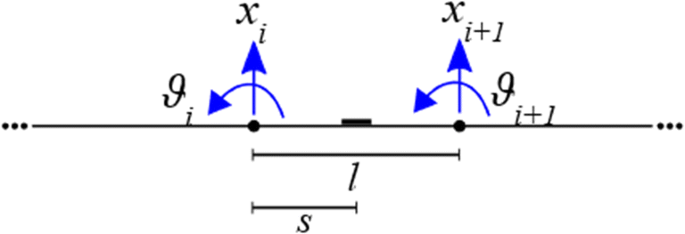
Definition of the sensed strain

$$ \varepsilon =\left\{-\frac{six}{l^ii}+\frac{12s}{l^3}\kern0.5em -\frac{4}{l}+\frac{6s}{l^2}\kern0.5em \frac{vi}{l^2}-\frac{12s}{l^3}\kern0.5em -\frac{ii}{l}+\frac{6s}{l^ii}\right\}\left\{\begin{assortment}{c}{ten}_i\\ {}{\vartheta}_i\\ {}{x}_{i+1}\\ {}{\vartheta}_{i+1}\end{array}\right\} $$
(37)
The 2 strain gauges accept been placed at 175 mm from the complimentary-end of the axle since this location ensures a good observability and a good signal-to-racket ratio, in detail for the vibrational manner of involvement.
-
a laser doppler vibrometer to get straight measurement of the velocity of a point near the gratis finish of the beam, which is the function of the system that vibrates the most.
Other sensor configurations could exist adopted provided that they ensure acceptable system observability.
In the light of all the critical issues discussed in Section 5, an accurate tuning of the land observer has been performed in this experimental campaign both through a wise synthesis of the system model and the tuning of the land observer gain.
Since the beam has negligible effect on the slip-tabular array, the tabular array dispatch \( {\ddot{x}}_s \) has been assumed equally the exogenous input for the model of the state observer, rather than force f A driving the skid-table (which is as well difficult to mensurate). \( {\ddot{ten}}_s \) has been measured through an ICP accelerometer placed on the moving tabular array (run across Fig. ane). Hence, the land-space model for the observer synthesis, that fits the one in (18) is the following one:
$$ \left\{\begin{assortment}{c}\ddot{\boldsymbol{q}}\\ {}\dot{\mathbf{q}}\end{assortment}\right\}=\left[\begin{array}{cc}-{\mathbf{M}}^{-1}\mathbf{C}& -{\mathbf{Thou}}^{-1}\mathbf{K}\\ {}\mathbf{I}& \mathbf{0}\end{array}\right]\left\{\begin{assortment}{c}\dot{\mathbf{q}}\\ {}\boldsymbol{q}\end{array}\right\}+\left\{\begin{array}{c}{\mathbf{M}}^{-i}\mathbf{B}\\ {}\mathbf{0}\stop{assortment}\right\}{f}_C+\left\{\begin{array}{c}-\mathbf{S}\\ {}\mathbf{0}\end{array}\right\}{\ddot{10}}_s $$
(38)
Model reduction has been then performed by retaining the 2 lowest-frequency vibrational modes (i.east. retaining 4 coordinates in the reduced society model), while discarding the v higher frequency ones. A outset-order, low-laissez passer filter with a cut-off frequency at 350 Hz has been also adopted to further reduce ascertainment spillover.
As for the observer proceeds matrix L (see (24)), it has been computed through the Kalman'south theory equally follows:
$$ \mathbf{L}=\mathbf{P}{{\mathbf{C}}_R}^T{\mathbf{R}}^{-1} $$
(39)
Matrix P is the solution of the fourth dimension-space Riccati's equation, matrices Q and R are parameters representing the expected measurement and procedure dissonance covariance matrices:
$$ {{\mathbf{A}}_R}^T\mathbf{P}+\mathbf{P}{\mathbf{A}}_R-\mathbf{P}{{\mathbf{C}}_R}^T{\mathbf{R}}^{-1}{\mathbf{C}}_R\mathbf{P}+\mathbf{Q}=\mathbf{0} $$
(40)
The sampling fourth dimension adopted is i ms, for trading-off betwixt the needs of high-rate command and interpretation, numerical stability and depression computational endeavor, while the numerical integration of the differential equations of the state observer has been done by means of the explicit 4th order Runge-Kutta scheme.
An example of the effectiveness of the reckoner is shown in Fig. ix, which compares the estimated and the bodily values measured by the vibrometer (upper figure) and the strain (lower figure) during a frequency sweep (but an extract is shown to provide a clearer representation). The measured and the estimated signals are virtually overlapped, and the estimation error is negligible. Additionally, it tin be noticed that the country observer filters measurement noise, such every bit for example the spike recorded in the speed measurement at about time one.3 south, thanks to the model used in the prediction phase.

Comparison of actual and estimated quantities
All these choices pb to an expected natural frequency of the desired manner that is 49.9 Hz, every bit computed through the model in (28). The same model reveals that the cosine between the theoretical expected eigenvector (i.e. the ane assuming feedback of the actual and full state vector, computed through the corrected model that includes moment of inertia of the added masses) and the one perturbed past the observer (i.e. the ane computed through the dynamic matrix in (28)) is college than 0.9999 for both the real and the imaginary part. The differences with respect to the target values (i.due east. without observer and with the full order model) are clearly negligible and therefore the pick of the reduced model has negligible impact on the overall solution. Hence, the proposed methodology is an constructive approach for the integrated design and for forecasting the issue of the land observer.
Experimental assessment of the eigenstructure assignment
The control gains take been computed through the method proposed by Ram and Mottershead (2007), and subsequently extended in Ouyang (2011) and Ouyang et al. (2013) for asymmetric systems, which provides an effective and reliable solution for the instance of rank-one control. However, whatever method could exist used.
The experimental results obtained evidence that the control scheme employed succeeded in boosting the achievement of the control specifications. Indeed, the desired mode shape of the airtight-loop pole at l Hz is very close to the desired one. Figure ten shows the mode shape identified experimentally (only the translational components of the eigenvector has been identified, and hence information technology is represented with a linear interpolation) and compares it with the desired one. The cosine of the angle betwixt the obtained way and the desired ane is 0.966. This is an splendid effect that approximates very tightly the theoretical expectations. The difference is mainly due to the approximation of the lumped masses through two masses with finite moment of inertia (as already discussed and shown in Fig. 7) and to the unavoidable presence of unmodeled and uncertain dynamics (particularly because of the piezoelectric actuator and his nonlinearities and departure from the ideal model). Indeed, the cosine of the angle betwixt the experimental mode and the best achievable eigenvector, i.e. the "numerical with bodily model" depicted through a black line in Fig. 11, is 0.997. This event fits very closely the theoretical expectations since the cosine between the best achievable eigenvector and the one computed from the augmented model in (28), which included the controlled organization and the observer, is 0.999. Hence, just a negligible downgrade of the result (i.e. from one to 0.999) is due to the observer because of a wise design of the observer itself, that has allowed reducing spillover. Over again, this result proves that the observer and the reduced model has negligible impact on the overall solution, due to a wise synthesis of the observer in accord with the theory proposed in Department 5.1.

Comparison betwixt the desired mode and the 1 obtained experimentally (cosine between the 2 vectors: 0.966)

Analysis of the spillover furnishings with hybrid control: comparing betwixt the theoretical expected eigenvector (with actual state feedback) and the one obtained experimentally (cosine between the two vectors: 0.997)
Tabular array 3 summarizes the cosine improvement due to the proposed hybrid control, by comparing the main results of the numerical and experimental investigation. Overall, a neat improvement has been obtained, by proving the effectiveness of theory adult and of the comprehensive method proposed, that includes the synthesis of the controller, of the observer and of the concrete modifications.
Conclusions
This paper introduced a hybrid method for structural optimization through eigenstructure assignment in an active cantilever beam by exploiting the concurrent design of the physical modifications of the system elastic and inertial parameters, and the synthesis of the land-feedback controller. The optimal concrete modifications shape the allowable subspace in such a style that it spans a closer approximation of the desired eigenvector compared with the one doable past the original system. The method is suitable for underactuated systems, such as the studied one, where the size of the set of achievable eigenvectors makes EA challenging: the concurrent use of both the techniques overcome the limitations of the utilize of either passive modifications or active control alone, by enlarging the set of assignable eigenpairs.
The optimal solution is computed by solving a rank-minimization problem with constraints on the design variables, that arises from the definition of the commanded subspace. A convex optimization problem is formulated through the semidefinite embedding lemma and the so-called trace heuristics, and reliable numerical solution can be performed.
The newspaper covers all the bug for the implementation of this control approach in a real system, including the synthesis of a state observer for replacing the bodily state with the estimated one. The employ of a reduced-guild observer, to let for real time computation, causes spillover of the closed-loop poles and perturbation of the style shapes that might severely downgrade the achievable performances. A model to cope with this issue is therefore presented and the coupling with the controller is shown.
The experimental results obtained are very satisfactory. Get-go of all, the proposed method succeeded in achieving a tight approximation of the desired performances both in terms of way shape and natural frequency: the cosine between the desired mode shape and the achieved ane is 0.966, while active control alone leads to 0.524. Secondly, the theoretical expectations closely fit the experimental results, thanks to a careful design of the state observer introducing negligible perturbation of the desired eigenpair: the perturbation due to the observer is small-scale and the cosine between the expected eigenvector and the one obtained in the testbed is 0.997.
References
-
Andry AN, Shapiro EY, Chung JC (1983) Eigenstructure consignment for linear systems. IEEE Trans Aerosp Electron Syst 5:711–729
-
Araújo JM, Dórea CE, Gonçalves LM, Datta BN (2016) Country derivative feedback in second-order linear systems: a comparative assay of perturbed eigenvalues under coefficient variation. Mech Syst Bespeak Procedure 76:33–46
-
Aydin E, Dutkiewicz M, Öztürk B, Sonmez M (2020). Optimization of rubberband spring supports for cantilever beams. Struct Multidiscip Optim 62:55–81. https://doi.org/10.1007/s00158-019-02469-3
-
Belotti R, Richiedei D (2018) Dynamic structural modification of vibrating systems oriented to eigenstructure consignment through active control: a concurrent approach. J Sound Vib 422:358–372
-
Belotti R, Richiedei D, Trevisani A (2016) Optimal design of vibrating systems through partial eigenstructure assignment. J Mech Des 138(7):071402 (eight pages)
-
Belotti R, Richiedei D, Trevisani A (2017) Concurrent blueprint of active control and structural modifications for eigenstructure consignment on a cantilever beam. In ASME 2017 International design applied science technical conferences and computers and information in engineering conference. American Lodge of Mechanical Engineers Digital Collection
-
Belotti R, Caracciolo R, Palomba I, Richiedei D, Trevisani A (2018a) An updating method for finite element models of flexible-link mechanisms based on an equivalent rigid-link system. Shock Vib 2018:1–fourteen. https://doi.org/10.1155/2018/1797506
-
Belotti R, Ouyang H, Richiedei D (2018b) A new method of passive modifications for partial frequency assignment of full general structures. Mech Syst Bespeak Process 99:586–599
-
Belotti R, Richiedei D, Tamellin I (2020) Antiresonance assignment in point and cross receptances for undamped vibrating systems. J Mech Des 142(2):022301 (7 pages. https://doi.org/x.1115/1.4044329
-
Caracciolo R, Richiedei D, Trevisani A (2008) Robust piecewise-linear state observers for flexible link mechanisms. J Dyn Syst Meas Control 130(3). https://doi.org/10.1115/1.2909600
-
Corr LR, Clark WW (2002) Active and passive vibration solitude using piezoelectric transducers and dynamic vibration absorbers. J Mech Behav Mater 13(2):117–134
-
Delissen A, van Keulen F, Langelaar Thousand (2020) Efficient limitation of resonant peaks by topology optimization including modal truncation augmentation. Struct Multidiscip Optim 61:2557–2575. https://doi.org/10.1007/s00158-019-02471-9
-
Fazel M, Hindi H, Boyd SP (2001) A rank minimization heuristic with application to minimum order system approximation. In Proceedings of the 2001 American Command Briefing 6:4734–4739
-
Fazel 1000, Hindi H, Boyd SP (2003) Log-det heuristic for matrix rank minimization with applications to Hankel and Euclidean distance matrices. In Proceedings of the 2003 American Command Conference three:2156–2162
-
Franklin GF, Powell JD, Emami-Naeini A, Sanjay HS (2015) Feedback control of dynamic systems. Pearson, London
-
Gaudenzi P, Carbonaro R, Benzi Eastward (2000) Control of beam vibrations by means of piezoelectric devices: theory and experiments. Compos Struct 50(4):373–379
-
Hauser BR, Wang BP (2018) Optimal design of a parallel beam arrangement with elastic supports to minimize flexural response to harmonic loading using a combined optimization algorithm. Struct Multidiscip Optim 58(four):1453–1465
-
Hehenberger P, Follmer M, Geirhofer R, Zeman K (2013) Model-based arrangement design of annealing simulators. Mechatronics 23(iii):247–256
-
Hernandes JA, Suleman A (2014) Structural synthesis for prescribed target natural frequencies and mode shapes. Shock Vib, Article ID 173786 2014 https://doi.org/10.1155/2014/173786
-
Jihong Z, Weihong Z (2006) Maximization of structural natural frequency with optimal support layout. Struct Multidiscip Optim 31(six):462–469
-
Kim Y, Kim HS, Junkins JL (1999) Eigenstructure assignment algorithm for mechanical 2d-club systems. J Guid Control Dyn 22(v):729–731
-
Lee J (2019) Multi-objective optimization case report with active and passive design in building engineering. Struct Multidiscip Optim 59(2):507–519
-
Moore B (1976) On the flexibility offered by state feedback in multivariable systems beyond airtight loop eigenvalue assignment. IEEE Trans Autom Control 21(5):689–692
-
Ouyang H (2011) A hybrid control approach for pole assignment to second-guild asymmetric systems. Mech Syst Indicate Process 25(1):123–132
-
Ouyang H, Richiedei D, Trevisaniv AV (2013) Pole consignment for control of flexible link mechanisms. J Sound Vib 332(2013):2884–2899
-
Palomba I, Richiedei D, Trevisani A (2015) Energy-based optimal ranking of the interior modes for reduced-order models nether periodic excitation. Shock Vib 2015:one–10. https://doi.org/10.1155/2015/348106
-
Palomba I, Richiedei D, Trevisani A (2017) Kinematic country estimation for rigid-link multibody systems by ways of nonlinear constraint equations. Multibody Syst Dyn 40(1):1–22
-
Preumont A (2011) Vibration control of agile structures, an introduction, 3rd edn. Springer International Publishing, Cham. https://doi.org/10.1007/978-94-007-2033-6
-
Ram YM, Mottershead JE (2007) Receptance method in active vibration control. AIAA J 45(3):562–567
-
Richiedei D, Trevisani A (2017) Simultaneous active and passive control for eigenstructure assignment in lightly damped systems. Mech Syst Betoken Procedure 85:556–566
-
Richiedei D, Tamellin I, Trevisani A (2019) A full general approach for antiresonance assignment in undamped vibrating systems exploiting auxiliary systems. In: Uhl T (ed) Advances in mechanism and machine science. IFToMM WC 2019. Mechanisms and machine science, vol 73. Springer, Cham, pp 4085–4094. https://doi.org/10.1007/978-three-030-20131-9_407
-
Richiedei D, Tamellin I, Trevisani A (2020) Simultaneous assignment of resonances and antiresonances in vibrating systems through inverse dynamic structural modification. J Sound Vib 485, 27 October 2020, 115552:xix. https://doi.org/10.1016/j.jsv.2020.115552
-
Sanjurjo E, Dopico D, Luaces A, Naya MÁ (2018) State and force observers based on multibody models and the indirect Kalman filter. Mech Syst Signal Process 106:210–228
-
Schulz MJ, Inman DJ (1994) Eigenstructure assignment and controller optimization for mechanical systems. IEEE Trans Control Syst Technol 2(2):88–100
-
Tang J, Wang KW (2004) Vibration confinement via optimal eigenvector assignment and piezoelectric networks. J Vib Acoust 126(1):27–36
-
Thomas S, Li Q, Steven G (2020) Topology optimization for periodic multi-component structures with stiffness and frequency criteria. Struct Multidiscip Optim 61:2271–2289. https://doi.org/10.1007/s00158-019-02481-7
-
Triller MJ, Kammer DC (1997) Improved eigenstructure consignment controller pattern using a substructure-based coordinate organisation. J Guid Control Dyn xx(5):941–948
-
Xiao M, Lu D, Breitkopf P, Raghavan B, Dutta S, Zhang W (2020) On-the-wing model reduction for large-scale structural topology optimization using principal components analysis. Struct Multidiscip Optim 62:209–230. https://doi.org/10.1007/s00158-019-02485-3
-
Yan K, Wang BP (2020) Two new indices for structural optimization of gratis vibration suppression. Struct Multidiscip Optim 61:2057–2075. https://doi.org/10.1007/s00158-019-02451-z
-
Zhai J, Zhao G, Shang L (2017) Integrated blueprint optimization of structural size and control organization of piezoelectric curved shells with respect to audio radiation. Struct Multidiscip Optim 56(6):1287–1304
-
Zhang J, Ouyang H, Yang J (2014) Partial eigenstructure assignment for undamped vibration systems using acceleration and displacement feedback. J Sound Vib 333(1):1–12
-
Zheng S, Zhao Ten, Yu Y, Sunday Y (2017) The approximate reanalysis method for topology optimization under harmonic strength excitations with multiple frequencies. Struct Multidiscip Optim 56(5):1185–1196
Acknowledgments
Open access funding provided by Università degli Studi di Padova inside the CRUI-CARE Agreement.
Writer data
Affiliations
Corresponding author
Ideals declarations
Conflict of interest
The authors declare that they have no disharmonize of interest.
Replication of the results
The Appendix proposes the Matlab lawmaking for the computation of the optimal structural modifications for hybrid control, by implementing the rank-minimization method in (16). It requires the toolbox YALMIP (https://yalmip.github.io). The data for replicating the exam tin can be obtained from the description of the examination rig provided in Section 6.
Additional information
Publisher'southward note
Springer Nature remains neutral with regard to jurisdictional claims in published maps and institutional affiliations.
Responsible Editor: Somanath Nagendra
Appendix
Appendix

Rights and permissions
Open up Access This article is licensed under a Creative Commons Attribution 4.0 International License, which permits utilise, sharing, adaptation, distribution and reproduction in any medium or format, equally long as you lot requite advisable credit to the original author(s) and the source, provide a link to the Creative Commons licence, and indicate if changes were made. The images or other tertiary party material in this article are included in the article'southward Creative Commons licence, unless indicated otherwise in a credit line to the cloth. If material is not included in the article's Creative Commons licence and your intended employ is not permitted by statutory regulation or exceeds the permitted use, y'all will need to obtain permission directly from the copyright holder. To view a re-create of this licence, visit http://creativecommons.org/licenses/past/four.0/.
Reprints and Permissions
Almost this commodity

Cite this commodity
Belotti, R., Richiedei, D. & Trevisani, A. Multi-domain optimization of the eigenstructure of controlled underactuated vibrating systems. Struct Multidisc Optim 63, 499–514 (2021). https://doi.org/x.1007/s00158-020-02709-x
-
Received:
-
Revised:
-
Accepted:
-
Published:
-
Issue Engagement:
-
DOI : https://doi.org/10.1007/s00158-020-02709-x
Keywords
- Optimal blueprint
- Eigenstructure assignment
- Structural modification
- Active control
- Rank minimization
mclaughlinacque1938.blogspot.com
Source: https://link.springer.com/article/10.1007/s00158-020-02709-x
0 Response to "Solve for the Exact Same Eigenvalues Again Using an Optimization Approach"
Post a Comment